
Growth · Google Ads

Google Ads agency that invests where the business is.

We do not buy clicks. We decide which searches deserve budget, which ad meets them, where the click lands and what counts as a result. A campaign is not judged by what the platform reports, but by what it returns to the business.

  • Search
  • Performance Max
  • Shopping
  • Display
  • Remarketing

The starting point

Spending more is not growing better.

Almost no account arrives idle. It arrives spending: live campaigns, clicks coming in and a report that goes out every month. What does not arrive is the link between that spend and what the business actually invoices.

What looks like a good signal

The question that decides

More budget

Does the demand you pay for want to buy?

If the demand being captured has no intention of buying, more budget simply brings more of the same. Volume grows; opportunities do not. Scaling only works when what you are scaling already paid off.

Lower CPC

Could that click ever become a customer?

Paying little for a click that was never going to convert is expensive all the same, and sometimes the more expensive click is the one that brings the customer. The useful comparison is not between clicks: it is between what an opportunity costs and what it is worth.

More conversions

Does that conversion mean real business?

When any form, any tap on a phone number or any page view counts as a conversion, the account optimises towards a goal that is not the goal of the business. And it does it very well: that is why the problem takes so long to surface.

More automation

What signals is the algorithm deciding with?

Performance Max and automated bidding work with whatever they receive. Given poor signals they optimise towards poor outcomes, and they do it fast and with the whole budget. Automating is not delegating judgement: it means having to set it first.

And a campaign can be well built and still not pay for itself, because much of what decides performance happens after the click.

What we manage

What Google Ads management includes.

No account needs everything, or in the same order. These are the capabilities we bring in depending on the starting point.

Strategy and audit

Understanding what is being paid for today and deciding where it is worth going in.
  • Account audit
  • Keyword research and search intent
  • Competitor analysis
  • Campaign and ad group structure
  • Budget allocation and priorities
  • Structure by country, language and market

Campaigns

Which formats come in, when each one makes sense and when it does not.
  • Search campaigns
  • Performance Max
  • Google Shopping, Merchant Center and product feed
  • Display
  • Remarketing
  • Brand campaigns

Ads and destination

What the user reads before the click and what they find after it.
  • Ad copywriting
  • Assets and extensions
  • Match types and negative keywords
  • Landing pages and messaging
  • Conversion work (CRO) on the pages already receiving traffic

Measurement and optimisation

Knowing what is working so the money can be moved with judgement.
  • Conversion tracking
  • Search terms analysis
  • Bidding and budget distribution
  • Reporting built for decisions
  • Scaling by market

When the blockage is not the campaign but what comes after the click, we solve it inside the same project: Web design, Custom web development and Ecommerce. Without changing supplier and without the spend carrying on paying for the problem.

How we run it

Built once. Managed for ever.

The first three moves put the account in order and happen at the start. The fourth is the one that decides the result, and it is the one that never ends.

  1. Audit

    What is being paid for, with what structure, with what measurement, and how all of that relates to the business. If the account starts from zero, the same work is done on the demand and on the offer.

  2. Structure

    Which campaigns exist, what each one is after, what budget belongs to it and what stays out. An orderly account is what makes results readable later on.

  3. Launch and learning

    We go in with conversions properly defined and let the account learn from the right signals. The first few weeks are data; they are not performance yet.

Live

Continuous reallocation

From here the work is deciding, week by week, where the money moves. The account changes because what it returns changes.

  • Search terms brought in and search terms excluded
  • Budget that goes up where there is return and down where there is none
  • Ads and landing pages tested and compared
  • Conversions reviewed so they keep meaning the same thing

An account is not handed over finished. It is handed over running, and what makes it profitable is what gets decided afterwards.

Measurement

Google Ads decides with what we feed back.

Inside the platform everything is measured in detail. What happens next —whether that contact was any good, whether they bought, whether it left a margin— is known only to the business, and the account can act on it only if we feed it back.

What the account receives

  • Impression
  • Click
  • Cost
  • Recorded conversion

This is as far as the signal reaches in most accounts

What the business knows

  • Qualified lead
  • Opportunity
  • Sale
  • Profitability

Pushing the signal further

When the business can say which contact became a customer, that information goes back to the account. The platform carries on deciding just as fast, but with a far better signal.

Not every project can close that loop: it depends on the CRM, on the sales process and on what can be recorded. When it cannot, we say so, we work with the signal there is and we improve what is within our reach. We prefer that to showing an attribution that does not survive a question.

No campaign can optimise better than its signal allows.

The proof

One real account, two years running.

Two years of continuous management on a real account, with the evidence in front of you.

RadioTaxi033

Taxi service · Google Ads and city-by-city acquisition

From a local operation in Barcelona to 23 cities.

Strategy

Booking a taxi is an immediate, local decision: people search and book within the same minute. Google Ads was the channel able to be there at that moment in every new city, while the organic work built the base more slowly.

Execution

Search campaigns split by city and by type of service, negatives worked so the account does not pay for something else, ad copy written to filter, and one landing page per territory. Two years of continuous management, with the budget moving between cities according to what each one returned.

Result

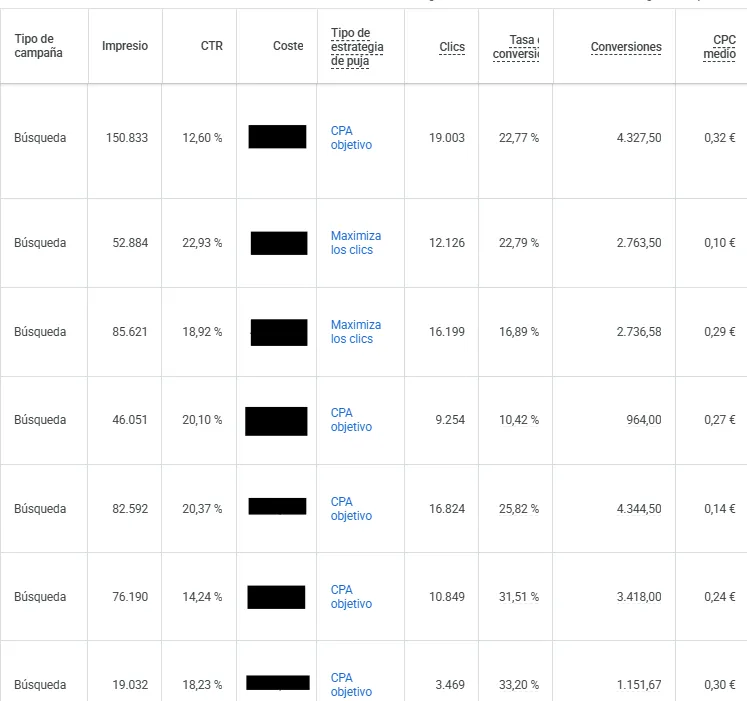
The service now operates in 23 cities across Spain, with the search campaigns holding a CTR of between 12% and 23% and conversion rates of between 10% and 33%.

23 citiesreached from a single acquisition strategy, with Ads and organic pushing in the same direction.

2 yearsof continuous management of the account.

Google Ads search campaign report for RadioTaxi033: campaign type, impressions, CTR, bid strategy, clicks, conversion rate and conversions. The cost column is hidden.
The elTaxi033 home page: the public site where a taxi is booked, with access by city. It is the page the campaign clicks land on.

Real account screenshot. Financial figures hidden for confidentiality.

An account shows clicks, CTR and conversions. What decides the investment is what happens after them: when those conversions can be tied to real opportunities and sales, the budget is allocated on different information.

Fit

When it makes sense to run Ads with us.

  • Your customers search on Google before they decide, and you want to be there with judgement, not at any price.
  • You already invest, but nobody can explain which part of that spend is generating business.
  • You want to grow without growing meaning only raising the budget.
  • You suspect part of the problem sits in the website, the offer or the measurement, and you want it solved alongside the campaigns.

Models we work with

  • Service businesses
  • B2B
  • Ecommerce
  • Mid to high ticket
  • Multi-region
  • International

If what you want is someone to switch campaigns on and send a report at the end of the month, there are cheaper options than us. What we do here is decide, week by week, where the money goes.

Frequently asked questions

Before you put a penny into Google Ads.

How much should we invest in Google Ads?

There is no single figure that works for everyone: it depends on the sector, on competition in the auction, on average order value and on how many searches with real intent exist in your market. The useful question before setting a budget is a different one: what an opportunity is worth to your business and how many you need each month. With that we can say whether the channel makes sense and where it is sensible to start, instead of picking a round number and seeing what happens.

How long does a campaign take to work?

Google Ads can bring visibility and first conversions within days, and that is its great advantage over organic search. Stable performance is another matter: at the start the account is learning and the data is not yet good enough to decide on. Well-founded decisions come once enough conversions have built up, not once a deadline has passed, and that depends on the volume of each business.

What does Google Ads management include?

What the industry calls PPC management: an audit or an initial plan, campaign structure, keywords and negatives, ad copy, setting up and reviewing measurement, budget management, continuous optimisation and reporting. When it is needed, work on the landing page comes in too: if the click lands on a page that does not answer the search, the campaign ends up paying for a problem that is not its own.

Can you work on our existing account? Who owns the account and the data?

Yes, and working on the account that already exists is the norm: its history has value and starting from zero throws it away. The account and the data always belong to the client. If the relationship ends at some point, the account stays where it is, with its history and its conversions, and the access is handed over.

Does Google Ads work if the website does not back it up?

It works worse, and it shows quickly. A campaign can bring in exactly the search you want and then lose half its value on the landing page: a message that does not answer the search, an unclear offer, or a form that asks for too much. That is why the page is part of the conversation from the start, and when the blockage sits there we say so, even if it is not what you came to buy.

Do you work on ecommerce and international campaigns?

Yes. In ecommerce much of the performance depends on the feed and on catalogue structure: titles, attributes, grouping by family or by margin, and campaigns separated by priority. Internationally, each market is treated on its own —searches, ads, budget and landing page per country or language— because mixing markets inside one campaign makes it impossible to read afterwards what is working.

Do you guarantee results?

No, and it is worth being wary of anyone who does: the result depends on the auction, on the competition, on the market and on the offer itself. What we do commit to is how decisions are made —on what basis the budget is allocated, what is measured and what gets corrected— and to saying so plainly when something is not working, even if the conclusion is that this channel is not for you.

Let’s talk

Tell us what you want to achieve with Google Ads.

We look at your starting point —what is being paid for today, where the click lands and what is being measured— and tell you what we would change first and why. If the blockage is not in the campaigns, we will tell you that too.

Where are things right now?
What investment are you considering?

The total for the project or, if it’s an ongoing service, the first-year investment.

The first thing will be to understand the problem, not to pitch you a service. And if we think it doesn’t make sense for us to do it, we’ll tell you that too.

Privacy policy

Cookie preferences

Choose what you allow. You can change it any time from the link in the footer.