
Technology · Custom web development

Custom web development for when your website needs to do more than display content.

Custom does not mean starting from scratch. It means the website behaves the way your company works: your capacities, your rates, your permissions, your statuses and your notifications. The work someone does by hand around the website, the website does.

  • Marketing websites
  • Web platforms
  • Private areas
  • Integrations

The starting point

The problem isn’t what your website doesn’t show. It’s what it can’t do.

Hardly any company hits the limit all at once. They notice it in the work that piles up around the website: checking by hand, keying the same thing in twice, remembering to send an email, bolting on one more plugin.

One rule, solved in pieces


Six pieces for one rule. None of them knows what the others are doing.

How it shows

  • The same data sits in three places and none of them is authoritative.
  • Some tasks only happen if somebody remembers to do them.
  • Every new improvement breaks something that already worked.
  • Half the company keeps hearing ‘the system won’t let us’.

With judgement

Not everything has to be custom-built.

Custom is not a premium tier. It is what appears when a need stops being ordinary. The same request, depending on how specific it gets, is best answered by something different.

The business bends to the tool

What the business asks forWhat answers it

Let people book online.

Use what already exists

The problem is common and well solved: a content management system, a payment gateway, an off-the-shelf tool that does exactly that.

In returnYou accept working the way the tool works.

Let people book online, with time slots and capacity per room.

Extend what is there

The foundation works and one specific part does not: a flow, a calculation, a screen, a permission, an integration nobody ships ready-made.

In returnYou inherit the good and the bad of that foundation.

Let people book online, with time slots and capacity per room, and if the deposit is not paid within twenty minutes, release the slot.

Build what does not exist

The rule belongs to your business and nobody ships it ready-made: capacities, your own rates, statuses, validations, permissions, processes that only make sense in your company.

In returnYou decide everything, and you maintain everything too.

The tool bends to the business

If an existing tool solves your problem well, we’ll say so and set it up. Charging to build something that already exists isn’t custom development. It’s just an expensive way of solving the same problem.

What sits underneath

One click on top. Nine decisions underneath.

The visible part of a custom website is almost always the smallest one. What makes it pay for itself is what happens after the click, and above all what happens when nobody is watching any more.

What the customer does

Presses ‘Confirm booking’.

What the system does

For the customer it was one click. For the business it is nine decisions nobody makes by hand any more, and three pieces of data nobody keys in twice.

When the website stops working alone

Data that comes in through the website should never be keyed again into the CRM, the ERP, the accounts or a spreadsheet. It is entered once and it travels. That is where a custom website stops being a separate piece and becomes part of how the company runs.

What we build

What goes into a custom web project.

Four layers, from the surface inwards. A project hardly ever needs all of them, but it almost always needs more than one — and the one you can see is only the first.

What you see

Marketing website, built to measure

when the website has to win work and rank, not just exist

  • Content architecture and technical SEO
  • Front-end development
  • Performance and load speed
  • A structure that can grow section by section
  • Accessibility and semantic mark-up
  • A content manager built around the team

This is where the visitor’s view ends

What people use

Platforms and private areas

when the user signs in, does things and comes back

  • Custom web applications
  • Private areas and customer portals
  • Admin panels
  • Users, roles and permissions
  • Statuses and life cycles
  • Multi-company and multilingual environments

What decides

Workflows and business rules

where everything that only makes sense in your company lives

  • Back-end development and business logic
  • Advanced forms and configurators
  • Bookings, availability and capacity
  • Rate and quote calculation
  • Validations and rules of your own
  • Payments, charges and subscriptions

What connects

Integrations and data

so a piece of data is only ever entered once

  • CRM and ERP integration
  • Our own APIs and third-party ones
  • Payment gateways
  • Ecommerce synchronisation
  • Automations and notifications
  • Migrations and data traceability

And here the project stops being on its own

When the block is not what the website does but how it is understood and moved through, or when the problem leaves the website altogether and lands in how the company runs internally, we solve it inside the same project: Web design and Custom software. You do not need to change supplier to cross that line.

How we pin it down

First we pin down what has to happen. Then we build it.

When a custom project starts, nobody knows exactly what they want: they know the problem. The work is closing down everything that could still mean anything, until what is left is a rule you can test.

  1. OpenThe conversation

    ‘We need people to be able to book online.’

    That is a goal, not yet a behaviour. Nothing here can be quoted without making it up.

    8 questions still open

    • per room or per place?
    • is there a capacity limit?
    • paid before or after?
    • who can cancel?
    • what about bank holidays?
    • different rate at weekends?
    • does someone on the team handle it?
    • what if they never turn up?
  2. NarrowedThe rules

    ‘Rooms by time slot, with capacity, and a deposit up front.’

    The exceptions show up, which is where the real project lives.

    4 questions still open

    • who cancels, and until when?
    • do regulars pay a deposit?
    • what happens on bank holidays?
    • can a slot be moved?
  3. TestableThe working prototype

    ‘If places are left and 30% is paid, the slot is held.’

    It is tested with real data before anything is built around it. Changing a rule here costs an afternoon; changing it at the end costs the project.

    1 question still open

    • what if the payment only half goes through?
  4. LiveThe system

    It books, it charges, it holds, and the team can see it.

    And from here it grows in phases, on a foundation nobody has to rebuild.

    Nothing left open to interpretation

Anything you cannot test is not defined yet. That is why a custom project gets pinned down before it grows, and not the other way round.

The proof

One booking, three places, one system.

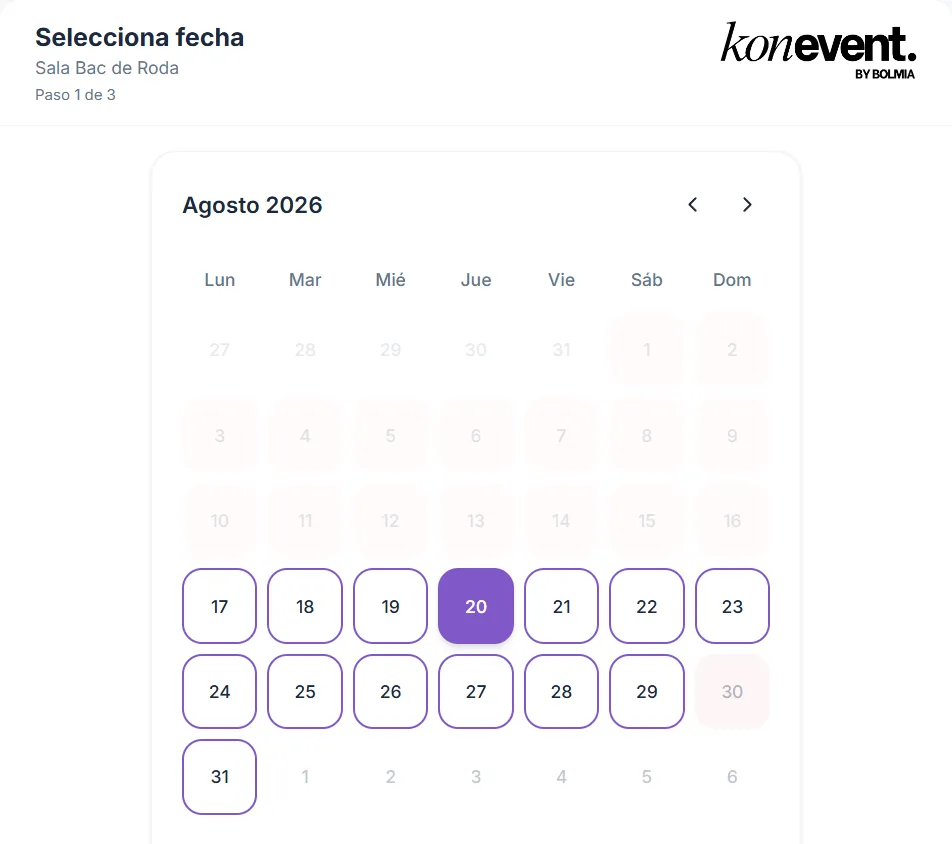
Konevent is a multi-company SaaS for booking and managing venues that we designed and built. We show it because you can follow it from the inside: the same booking is chosen by a customer, seen by the team, and can be created by hand by whoever answers the phone.

Konevent

Booking and operations SaaS

From availability to payment, one single system.

What the customer sees
Public booking widget: the end customer picks a day from the room’s availability calendar.
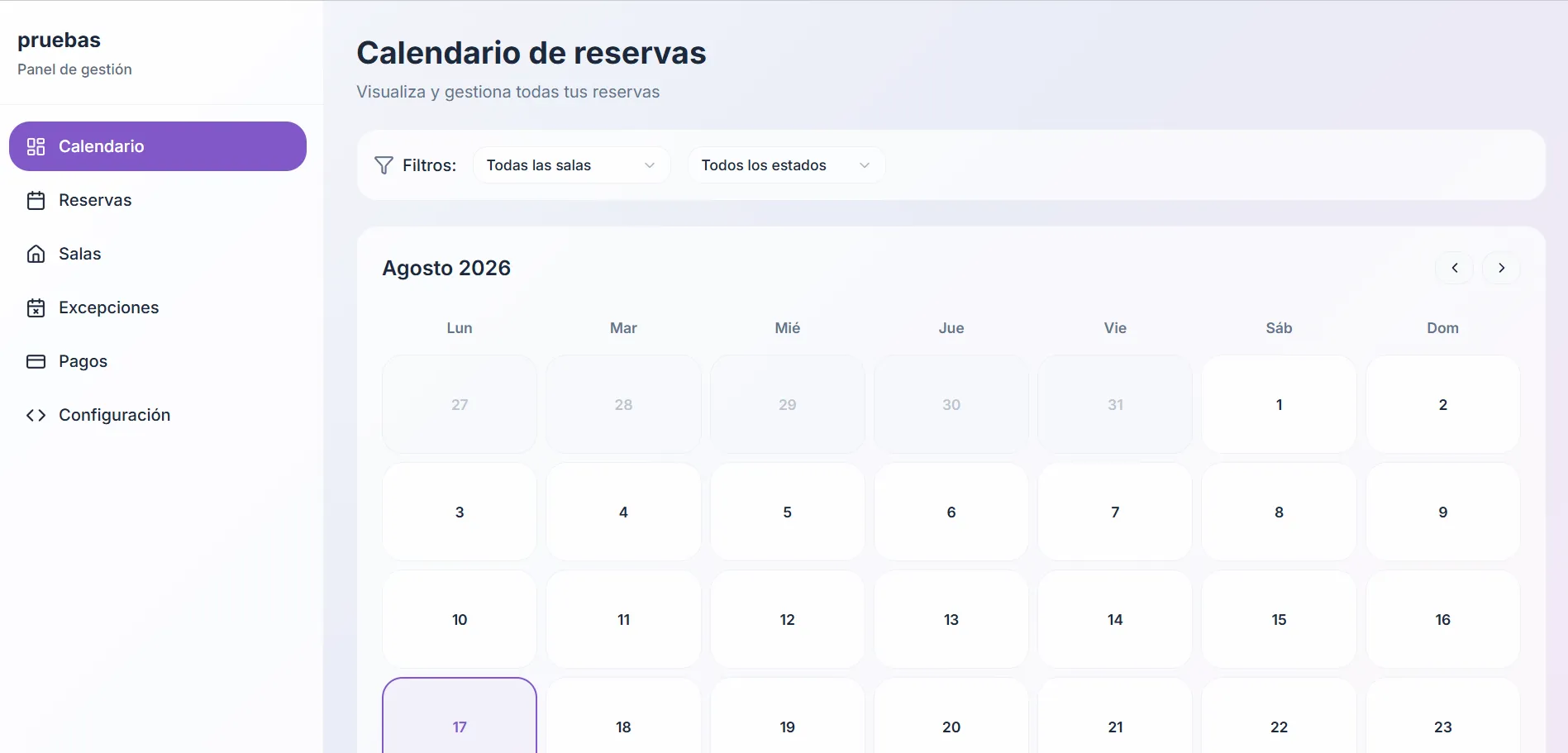
What the team sees
Booking calendar in the Konevent management panel: the full month, with filters by room and by status.

What it had to do

Rooms with time slots and capacity, real availability at any moment, bookings made by the end customer and bookings created by the team, payment with its amount and its method, and a status that means the same thing wherever you look at it from.

What was built

A multi-company system where availability is what rules: the public widget only ever offers what is genuinely free, the panel shows the whole month by room and by status, and a booking created by hand goes in through the same door as one made online. There are never two versions of the truth to reconcile afterwards.

+200 companiesrely on Konevent month after month.

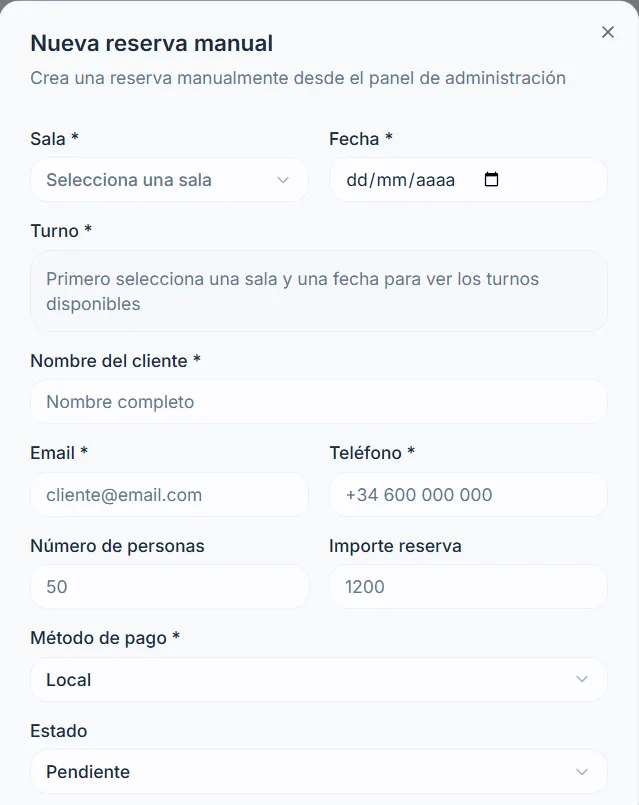
What happens when they phone
New manual booking form: room, date, time slot, customer, number of people, amount, payment method and status.

Real product screenshots, with demonstration data.

All the customer sees is a calendar with free days. Underneath there are rooms, slots, capacity, amounts and a team working on that very same booking.

Where it fits

When it makes sense to call us.

  • Your team does by hand what the website could do on its own.
  • The business needs something the current website will not allow.
  • The same data lives in the website, in a spreadsheet and in another tool.
  • Every new feature breaks one of the old ones.

We work on

  • Marketing websites
  • Web platforms
  • Private areas
  • Customer portals
  • Ecommerce with rules of its own
  • Projects built in phases

If what you need is a company website that explains clearly what you do, you do not need custom development: you need a good website. That is a different job, and we will say so.

Frequently asked questions

What people ask before they commit.

What is the difference between custom web development and a template site?

A template brings a fixed set of behaviours and the project adapts to them. Custom web development starts from how the company works —its rules, its statuses, its permissions, its processes— and the website is built to run them. The difference does not show on the home page: it shows in what the system will and will not let you do once the business grows.

Can you work on the website we already have, or do we start from scratch?

Starting from scratch is rarely necessary, and when we propose it we explain why. We can build on what is already there, replace only the part that limits you —a flow, a panel, an integration— or build a new core and migrate in phases. Rebuilding everything only pays off when the current foundation costs more to maintain than to replace: a custom web development firm that opens by suggesting you bin the lot is usually selling hours, not judgement.

What if an existing tool already solves what we need?

Then we use that tool, and we tell you before we start. Building from scratch something that is already solved adds nothing and makes future maintenance dearer. Custom development earns its place when there is a real need that off-the-shelf solutions do not cover well — not as the default option.

How much does a custom web development project cost?

It depends on the scope, on how many business rules are involved, on the integrations, and on whether users, permissions and statuses come into it. A custom marketing website does not cost the same as a platform with a private area, payments and an ERP connection. What we always do is pin the scope down before giving a number: quoting an undefined need means quoting two different projects at once.

How long does it take, and can it be done in phases?

Yes, and on most projects it is the better option. We define a core that already delivers value on its own, put it live and grow from there. It lets you validate earlier, spread the investment and avoid discovering at the end that a rule had been misunderstood. Timescales follow the functional complexity, not the number of pages.

Can it integrate with our CRM, ERP or other tools?

Yes, and it is usually the very reason a project is built to measure. The website can connect by API to the CRM, the ERP, the payment gateway, the accounts system, the ecommerce platform or internal tools, so a piece of data goes in once and travels on its own. Where no API exists we look at what is possible and say plainly what can be automated and what cannot.

Who owns the code, and what maintenance does it need afterwards?

Scope, ownership and terms of use are agreed in writing before we start, and on a business project the code and the data normally belong to the client. After that, every digital system needs maintenance: updates, security, performance, adjustments and new features. A custom website is not finished the day it goes live — it settles down, and it keeps evolving with the company.

Let’s talk

Tell us what your website needs to do and cannot.

You do not need to bring a technical brief. Tell us which process is costing your team time, what the current website will not allow and which tools it would have to talk to, and we can tell you whether this is a job for custom development or for something that already exists.

Where are things right now?
What investment are you considering?

The total for the project or, if it’s an ongoing service, the first-year investment.

The first thing will be to understand the problem, not to pitch you a service. And if we think it doesn’t make sense for us to do it, we’ll tell you that too.

Privacy policy

Cookie preferences

Choose what you allow. You can change it any time from the link in the footer.