
How much does a custom website cost in Spain: scenarios, what each one includes and what you pay afterwards
Four indicative cost scenarios for a custom website in Spain, with their scope and assumptions, what pushes the price up and what you pay every year.
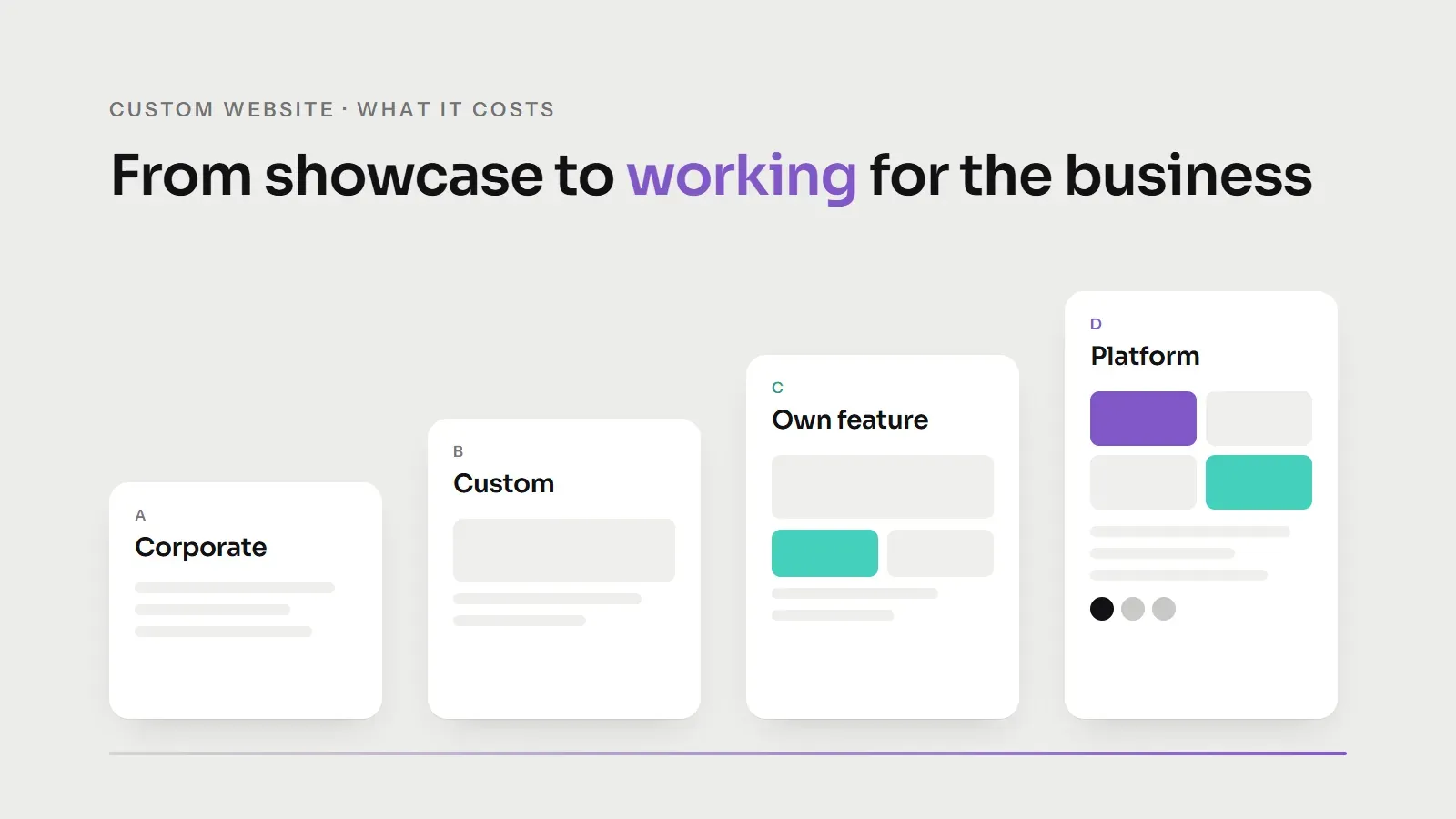
There is no single price for a custom website, because “custom website” describes very different projects. To get your bearings before requesting proposals, a scenario is more useful than an average figure. In Bolmia’s indicative estimate, with the assumptions set out below, a corporate website built on a template or a content management system often comes in under €10,000; a website with structure, design and content management planned around the business sits between €10,000 and €25,000; a website with a custom-developed feature, between €15,000 and €60,000; and a platform with a client area, payments and integrations, between €60,000 and €150,000 or more.
These are scenarios, not market minimums or Bolmia’s rates: a specific project may come in below or above depending on what it includes. What separates one scenario from another is hardly ever the design: it is the business rules, whether they are handled by a tool that already exists or have to be developed, and the connections with other systems. If what you are looking for is someone to build it, on our custom web development page we explain how we choose between WordPress, the website you already have or bespoke development. Here we focus on the money.
Four indicative scenarios
| Scenario | Order of magnitude (€, excl. VAT) | Scope it assumes |
|---|---|---|
| A · Corporate site on a template or CMS | Often under 10,000 | Presenting the company and capturing enquiries; extra features through ready-made plugins or services |
| B · Custom website | 10,000 – 25,000 | Its own structure and design, carefully worked content, a CMS planned for the team, several languages |
| C · Website with a feature of its own | 15,000 – 60,000 | One or two features developed for the business: a quote calculator with its rules, bookings with its own availability, a simple private area |
| D · Web platform | 60,000 – 150,000 or more | Several user profiles, payments, connection to an ERP, CRM or invoicing system, a management dashboard |
The assumptions behind each scenario:
- A. Between five and fifteen pages, one or two languages, content supplied by the company and a design adapted to the brand on an existing foundation. If it needs bookings, payments or an advanced form, they are handled with a plugin or a configured external service, not with bespoke development.
- B. A structure designed around what the company sells and how people search for it, several page templates, content worked on together with the company, two or three languages, migration of the previous website and enquiry tracking. No business logic of its own.
- C. Everything in B plus one or two features that no tool handles the way the business needs, written and tested for it. The amount depends on how many rules each feature has and whether it touches other systems.
- D. Users with different permissions, payments, data that is entered once and reaches the ERP or CRM, and a dashboard for the team. From this point on, the website is in practice software used through the browser.
How to read the table:
- The scenarios overlap. A custom website with many languages and a lot of content can go over €25,000, and a quote calculator with few rules can cost considerably less than its scenario suggests. What is inside matters more than the label.
- There is supply below this, and it is legitimate. There are websites for well under €10,000, especially with templates, small studios or freelancers. For a company that only needs to present itself, that may be the right decision.
- Where they come from. Clutch’s web development pricing guide, updated on 12 November 2026, states that web development projects in its directory typically cost less than $10,000, although the average rises to $66,499: the fact that the average is so much higher than the typical project shows that a few large projects pull it up. Scenarios C and D are based on the bands we publish in our guide to how much custom software costs (in Spanish). Further down, real public contracts for comparison.
Integrating an existing solution or developing a feature of your own
This is the decision that moves the budget most, and it is worth taking feature by feature.
Integrating means using something that already exists and configuring it: a booking plugin for WordPress, a payment gateway, an appointment widget from an external service, a form connected to the CRM through the connection that CRM already offers. For example, WooCommerce’s official booking extension, WooCommerce Bookings, lets you sell appointments, reservations, rentals or classes by date or time slot, and its published price is €225 a year. On top of that comes the work of installing it, configuring it and adapting its look, but there is no booking logic to program.
Developing means writing the feature for that business because what exists does not fit: availability depends on the company’s own resources (rooms, technicians, machinery), the price comes from rules only that company has, or the data has to travel to and from a system that has no ready-made connection. Here you pay for understanding the rule, writing it, testing it and maintaining it.
Integrating is neither worse nor better: it is cheaper and faster as long as the tool fits, and it means accepting its limits, its fees and its changes. Developing costs more at the start and gives you control. A single project can include both.
What fits in each scenario
Scenario A covers a website that presents the company well: a clear structure, a design adapted to the brand, contact forms, a blog and a CMS so the team can change text and images. Bookings, payments or a catalogue also fit, if they are handled by an existing tool that matches how the business works.
Scenario B covers a custom website in the strict sense: the structure is designed around what the company sells and how people search for it, the content is worked on with the company, there are several languages and the CMS is configured so the team can edit exactly what it needs without breaking anything. This is where it is decided whether the website wins business or simply exists.
Scenario C is where features of its own appear: a quote calculator that turns measurements and options into a price using that company’s rules, bookings whose availability depends on its own resources, a catalogue with each client’s price and discount, a private area where clients check their own information. Each one is a business rule built into the website, and the cost lies in understanding it, writing it and testing it.
In scenario D the website is already a platform: users with different permissions, payments, a connection with the ERP or CRM so that data is entered only once, a management dashboard for the team. Here the cost resembles that of business management software more than that of a website.
Public contracts for comparison
Public sector contracts have their own rules, but they publish the subject, amount and date, and serve as an external reference:
- In November 2025, Zaragoza City Council awarded the design and development of a prototype portal on the design system of its e-government site for €13,000 excluding VAT, with 60 days for delivery. The tender amount was €14,995 excluding VAT.
- In April 2025 it awarded the development of a web application so that the production department of a municipal company can create, manage and run its activities for €10,050 excluding VAT.
- In February 2024 it awarded the development and maintenance of an application, for mobile and desktop, for submitting prior notices of minor building works and paying the fee, with corrective maintenance and support, for €59,125 excluding VAT, against a tender amount of €73,905.69.
- In March 2026, the Cuadrilla de Ayala (a grouping of municipalities in Álava) awarded the redesign, adaptation and management of its website, together with the maintenance and management of its other websites for four years, for €31,549.55 excluding VAT, against a base budget of €77,000.
The last example teaches something useful: the design of a website and its management over several years can go in the same contract. If you compare a quote that includes maintenance with one that does not, you are not comparing like with like. And the gap between the tender amount and the awarded amount is a reminder that the same website can attract very different proposals.
What pushes the price up
- The structure. A ten-page website is not the same as one with a page for every service and every city, designed to be found in every place where you work.
- The content. Whether the company supplies the text, photos and videos or they have to be produced. Many websites are delayed waiting for content, not code.
- The languages. Each language is another version of every page, every form and every automated email.
- What the team needs to be able to edit. A CMS that lets you change text is simple; one that lets you change prices, services and notices without breaking anything has to be designed.
- Features that no tool handles. Calculating a price with your own rules, booking your own resources, generating a document. Each one adds rules that have to be written and tested.
- Users and permissions. As soon as there is a private area, you have to decide who sees what and how they log in, and pay closer attention to security.
- Integrations. Connecting with the CRM, the ERP, invoicing or a payment gateway. If the system already offers the connection, it is usually a matter of configuring it; if not, it has to be developed, with its documentation, its limits and its failures.
- Migration. Moving content from the current website and keeping the URLs that already rank, so as not to lose search engine traffic.
- Performance and tracking. Loading quickly on mobile and knowing where enquiries come from takes dedicated work; it does not happen on its own.
Template, content management system or custom
Three paths, not two:
- A template is enough when the website only has to present the company and capture enquiries, and nobody needs it to do anything else.
- A content management system such as WordPress, adapted to the business, suits most corporate and commercial websites. WordPress is free software, licensed under the GPL, so there is no licence fee to use it, and the team can manage the content without depending on anyone. Its plugins handle many features without bespoke development. The work lies in the structure, the design and the content.
- Custom development pays off when the website has to do something no foundation provides out of the box, or talk to other systems. It does not have to replace the above: often only that part is developed, on top of the website that already exists.
We cover what a business gains with each option in premium website or cheap template (in Spanish).
Three real websites, three different jobs
We do not give project prices, but we can show what separates one type of website from another with published work in our cases:
- elTaxi033, the structure we built for RadioTaxi033, a taxi company in Barcelona: the work lies in the architecture, one page per city so that someone looking for a taxi in theirs finds a page that talks about it. Today there are 23 cities with the same structure, without it becoming a platform.
- Obrescat, a renovation company in Barcelona and a client of ours: the public website has one job, capturing quote requests. What it calculates and controls (the quote, expenses, the bank and the estimated margin of each job) lives in a separate dashboard with no public side. Separating the two allowed the website to remain a website.
- Kavela is Obrescat’s custom kitchen brand and a Bolmia client; Bolmia built its website and the tools it commissioned (quote calculator, dashboard, renders). Its nine-step quote calculator works out an indicative price range including VAT on the server and draws a floor plan and elevation diagram from the chosen configuration; everything submitted reaches a management dashboard. Payment for the design, on the other hand, was integrated with Stripe rather than developed. The website contains a business rule of its own, and that puts it in a different scenario.
What you pay afterwards
The price of building is not the total cost. A website in use has recurring costs:
- Domain, renewed every year with the registrar.
- Hosting, suited to what the website does. For a corporate website, a shared plan or managed WordPress hosting may be enough. A website with a private area, payments or integrations usually also needs a database with automatic backups, a staging environment where changes are tested before going live, and someone monitoring the service; that can be provided by managed hosting or a cloud server. As an order of magnitude, the smallest cloud server from Hetzner costs from €5.49 a month excluding VAT, with no administration included; the real cost depends on traffic, backups and who administers it.
- Security certificate. Today it can be free with authorities such as Let’s Encrypt, but someone has to renew and monitor it.
- Updates to the CMS, plugins and system, also for security.
- Licences and fees for plugins, templates or integrated external services, if they are used.
- Backups and testing them: a backup that has never been restored may or may not work.
- Fixes and ongoing development. On a website with its own features or integrations, fixing what turns up with use and adjusting the rules when the business changes.
There is no standard maintenance percentage for websites. What helps is a quote that separates the build from the recurring costs and states what each item includes.
What a website quote should include so you can compare it
- what the website has to achieve: present, win business, sell, provide a service;
- the page structure and how many different design templates;
- who supplies the content and how many languages;
- what the team will be able to edit without help;
- each feature, described, and whether it is handled with an existing tool or developed;
- the integrations, one by one;
- the migration of the current website and how the URLs that already rank are kept;
- testing on mobile and in the usual browsers;
- tracking: where enquiries come from;
- hosting: where, what it includes (backups, staging environment), who pays for it and who administers it;
- who owns the domain, the code and the access credentials;
- support after launch and the terms of maintenance;
- the expected recurring costs, including third-party licences and fees;
- milestones and payment terms.
Hypothetical example: two quotes of €6,000 and €30,000 for “the same website” may be quoting for different things; perhaps one integrates a booking plugin and the other develops its own system. This list helps you find out. If the website you have in mind is really an application, the guide on how to choose a custom software development company (in Spanish) gives more criteria for comparing proposals.
How we approach it at Bolmia
We do not give a figure before understanding what the website has to do. We start from what the company sells, who buys from it and how its team works, and with that we decide what to build it with: WordPress or another foundation that fits, the website it already has, or custom development. If what you need is handled well by a tool that already exists, we tell you and integrate it. And on larger projects we propose phases: a core that already delivers value, live, and extensions on top of that foundation.
If you are requesting quotes for your website, tell us what it has to do and we will help you see which part is integrated and which part is developed. And if you would like to see how we work first, here is our custom web development service for businesses.
Frequently asked questions
What does a custom website cost on average in Spain?
There is no independent statistic that gives a reliable average price for Spain. What exists are rates declared by agencies, directories and specific public contracts. That is why it is more useful to compare your website with a scenario of similar scope. In Bolmia's indicative estimate, a corporate website built on a content management system often comes in under €10,000, a website with its own structure and design between €10,000 and €25,000, and a website with custom-developed features or a private area above that. These are scenarios with specific assumptions, not minimum prices or Bolmia's rates.
Do the amounts include VAT?
No. The amounts in this article exclude VAT, which is how business-to-business quotes and the public contracts cited are expressed. When comparing proposals, check that they all state it in the same way.
Can I have bookings or payments on an inexpensive website?
Yes, if they fit a solution that already exists. A booking plugin, a payment gateway or a widget from an external service can be integrated for much less than it costs to develop that feature. The cost rises when the rule is specific to the business and no tool handles it, or when it has to be connected to the company's other systems.
Can a WordPress website be custom?
Yes. WordPress is free software and there is no licence fee to use it, and for many corporate websites it is a good foundation. What makes it custom is not the tool, but that the structure, design, content and what the team can edit are planned for that business, and that whatever the foundation does not provide out of the box is developed on top of it.
How much does it cost to maintain a website each year?
It depends on what it does. A corporate website needs a domain, hosting, updates and backups; a website with a private area, payments or integrations also needs bugs fixed, someone watching that the connections keep working, and ongoing development. Ask for the quote to list these costs separately from the build.